Limb eruption, S1 radiation storm, sunspot region 2371
Thursday, 18 June 2015 12:23 UTC
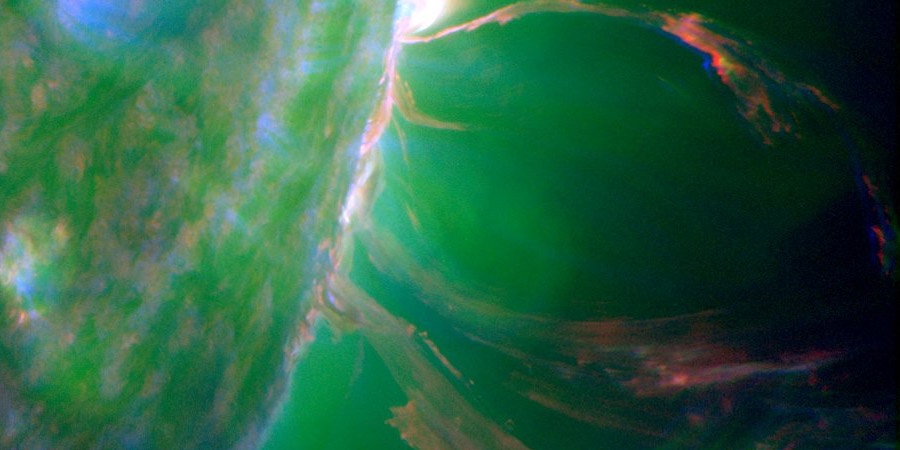
Early this morning we observed an M1.2 solar flare (R1-minor) peaking at 01:27 UTC from sunspot region 2365 at the West limb. The solar flare was accompanied by a gorgeous prominence eruption and launched a stunning coronal mass ejection.
A closer look at imagery from SOHO reveals that the coronal mass ejection is not aimed at Earth which was to be expected considering the source location of this event. Coronagraph imagery show that the coronal mass ejection which leaves the Sun at a speed of about 650km/s only forms a partial halo that will pass well south-west of Earth.
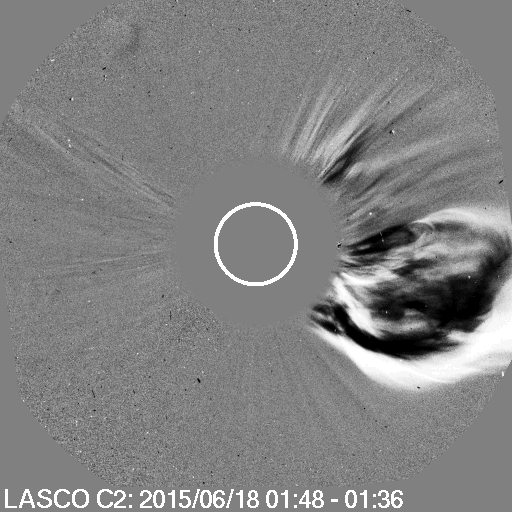
Image: SOHO/LASCO C2 difference image showing the coronal mass ejection of this morning.
The eruption also caused a minor S1 solar radiation storm here at Earth which is still in progress at this time. This is nothing to be concerned about as it only affects HF radio signals through polar regions.
Note that this eruption also surged the low energy protons and electrons at ACE. This is caused by this morning eruption and does not indicate that the coronal mass ejection is directed at Earth.
Sunspot region 2371
We understand that amazing eruptions like these beg the question: could there be more eruptions like these in store for us?
Answer: maybe.
There is a sunspot region on the earth-facing disk right now which is moderately complex and that is sunspot region 2371. This sunspot region is showing signs of growth and is already a Beta-Gamma sunspot region. A closer look at SDO imagery shows however that a Beta-Gamma-Delta classification can already be made. An M-class (R1-R2) solar flare from this sunspot region is very much possible in the coming days.
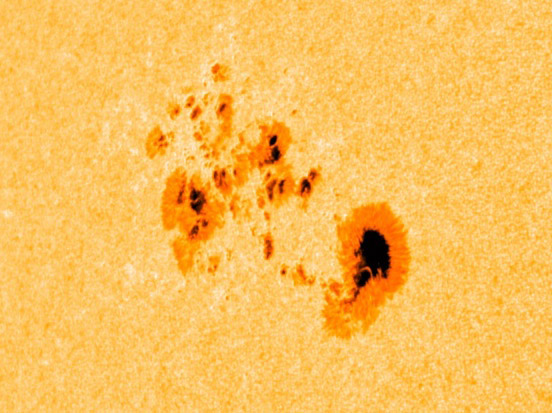
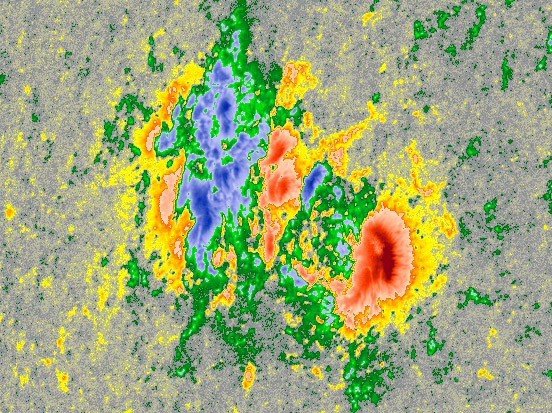
Images: SDO/HMI images showing the (magnetic) layout of sunspot region 2371.
Thank you for reading this article! Did you have any trouble with the technical terms used in this article? Our help section is the place to be where you can find in-depth articles, a FAQ and a list with common abbreviations. Still puzzled? Just post on our forum where we will help you the best we can!
Latest news

X1.5 solar flare

M2.7 solar flare, CME arrival possible

Complex sunspot region 4366
Latest forum messages
Support SpaceWeatherLive.com!
A lot of people come to SpaceWeatherLive to follow the Solar activity or if there is a chance to see the aurora, but with more traffic comes higher costs to keep the servers online. If you like SpaceWeatherLive and want to support the project you can choose a subscription for an ad-free site or consider a donation. With your help we can keep SpaceWeatherLive online!


Space weather facts
| Last X-flare | 2026/03/30 | X1.5 |
| Last M-flare | 2026/04/09 | M1.0 |
| Last geomagnetic storm | 2026/04/03 | Kp7- (G3) |
| Spotless days | |
|---|---|
| Last 365 days | 3 days |
| 2026 | 3 days (3%) |
| Last spotless day | 2026/02/24 |
| Monthly mean Sunspot Number | |
|---|---|
| March 2026 | 85.9 +7.7 |
| April 2026 | 97.2 +11.3 |
| Last 30 days | 95.6 +37.2 |